Sunday, March 6, 2011
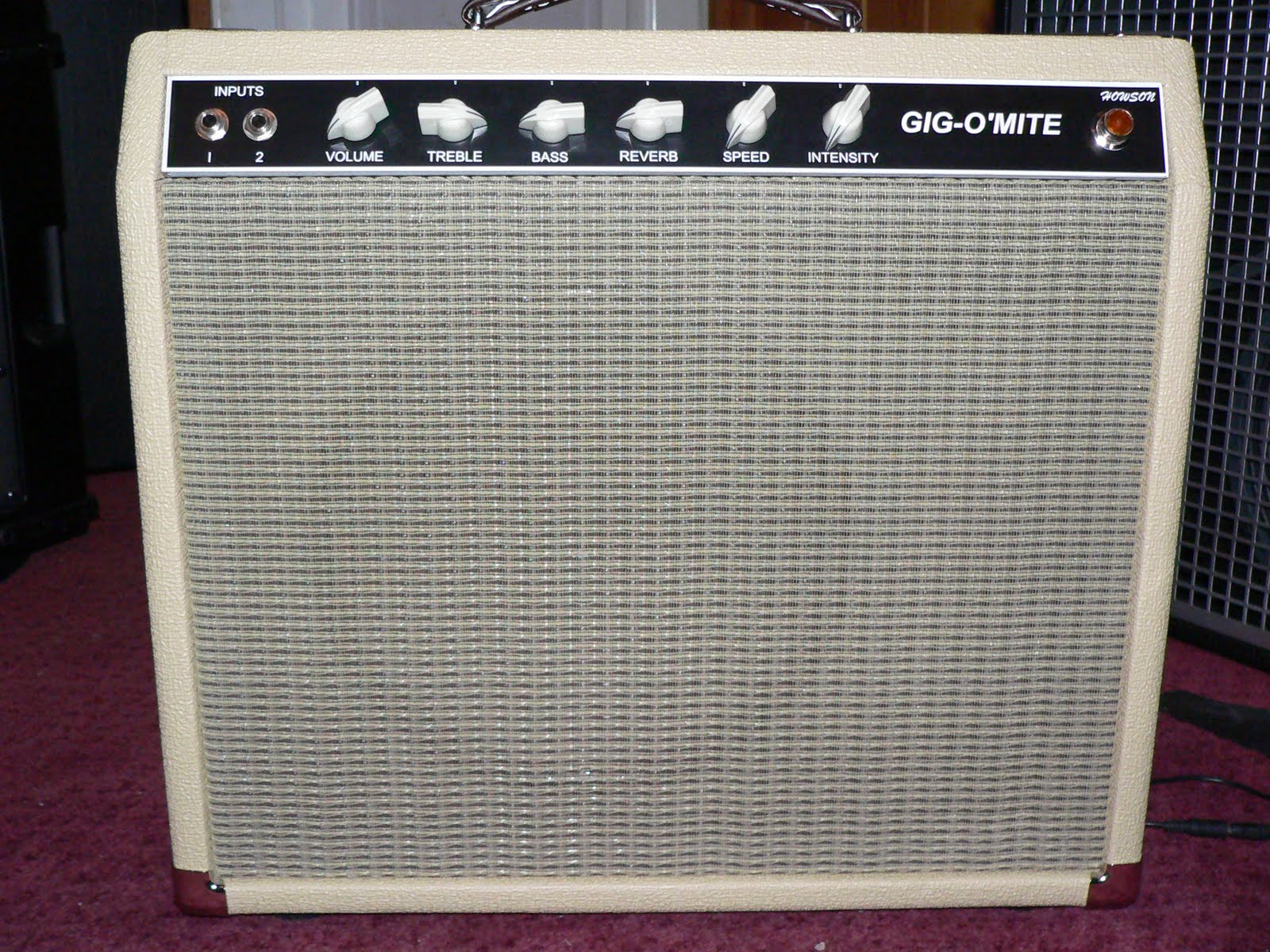
Howson Gig-O'Mite - Ultimate Gigging Amp?
Sunday, October 24, 2010
Youtube Clips Posted
Equipment featured in the various clips:
Parker Dragon Fly DF524, Korina Limited Run
Manlius Pickups: Modern Vintage Plus Bridge, Chicago Blues Neck and Middle
Pure Sixty Four Nytro II KT66 Head w/1x12 Cabinet and Silver Series Speaker
Digitech HardWire RV-7 Digital Reverb
Diamond Compressor*
Hermida Audio Zen Drive*
Wampler Analog Echo*
Digitech HardWire CR-7 Chorus*
*used on only some of the clips
Stay tuned - more clips and blog posts coming about this awesome rig shortly!
Monday, September 27, 2010
Check the obvious stuff first, bonehead!
I pulled up to a gig recently after being hit just a day and a half earlier with the worst sinus infection of my life. Wondering if I'll even be upright after the gig, I unload my truck and setup my stuff. Keep in mind that in addition to my guitar rig, I've recently added a keyboard and just days prior had finished wiring up a rolling rack that holds a combination of mixer/monitor gear for in ear monitoring as well as my acoustic processing. In other words, my portion of the load in and setup is always a little more involved than the rest of the band and I'm already feeling crappy.
I'm there early and, though feeling pretty terrible physically, am looking forward to playing. This is a relatively new venue for us, so its kind of exciting and I knew our little following would be there so I really wanted to make a good showing. This would soon prove to be a chellenge.
Immediately upon making the initial connections and testing out my various signals, I realized how terrible my guitar sounded. I've put more time and money into this rig than I care to admit, but it has always served me well and I take great pride in my tone and the frequent comments I receive from complete strangers about it. I did make some recent guitar and pickup changes and even halved the output power of my beloved Pure64 amp, so I'm immediately thinking it was one of those things that I did that was causing this terrible, thin, high-endy, honky, quacky sound to come out of my rig. Maybe my new Parker DF524 really was thin sounding as I had feared or that I really needed my recently ordered Manlius pickups to arrive. Maybe those TV Jones pickups in my Gretsch Pro Jet were adjusted improperly. But the SG sounded crappy too, and that's always been consistently wonderful. Maybe I had lost a tube or had a funky cord somewhere in my chain. Or maybe it was that occasionally temperamental switch on one of my drive pedals acting up again. The point is that I probably could have gotten better tone out of a 1984 Peavey Decade (remember those?) than I was hearing right now. All I kept thinking is that this sound guy - who kind of had a chip on his shoulder already - thinks I am a complete id10t with too much money to spend on gear I didn't have any clue how to use.
Still having a lot of sinus pressure and with show time coming closer and closer, I had to do whatever necessary to move on. So I played with the EQ on the amp, tried to dial out the badness and dial in some goodness in ways that I've never ran the EQ with only little success and went on with the show. Probably should have just brought in my backup amp, a very cool little Fender Super Champ XD and played the gig with that. Mic'd up it would have been just fine.
So we start the set, and the band's a little rough anyway. I'm sick, my tone sucks, its only our second gig with IEMs, we're at a new club and I'm just trying to get through the night. Set 1 done and over with. OK - got through it. What the h-ll is wrong with my stuff?!
Second set starts and we're starting to cook and finally get into our groove. The people are into it, I'm feeling worse and my tone still sucks. Some of the new songs we introduced tonight also sucked, but we move on. Maybe its just the pressure in my ears causing me to hear things in a degraded state, but everything else sounds great in the IEMs including the pristine clarity of my sinus pressure induced ultra nasaly voice through an all too accurate Shure Beta 87. My God what a great mic, but I digress...
The second set is nearing a close, thank God, and it turns out the elusive problem is about to be revealed. We approach what would normally be one of my favorite times in the night where I strap on (yeah, I chuckled too) my beloved Gibson Custom VOS SG in preparation to cover a couple of G&R songs that I usually nail and a great sing along by Journey to close the set. Knowing I'll be using my wah soon (the awesome Fulltone Clyde Deluxe), I look down to ensure the chicken head knobs on the side are in the proper position and I NOTICE THAT THE FREAKIN' WAH LED INDICATOR WAS ALREADY ON! It had been the entire night.
I spent nearly two thirds of the night playing through a half-cocked wah pedal and didn't even know it. My God I am so stupid and should probably just give up playing let along my quest for ultimate tone!OK, so maybe I can legitimately blame this oversight on some extreme head congestion, but COME ON! I guess the moral of this longer than necessary story is: check the obvious stuff first, bonehead!
God Bless,
J.Vincent
Monday, March 8, 2010
Quick update on the PRS DGT
The DGT Pickups
These are really interesting and took some getting used to. As expected, the split humbucker tones are decent, but still sound like split humbuckers. These are credible for some stratty or even more tele-like tones, but definitely usable, but come with the predictable considerable drop in output level when operating in single coil mode.
Moving away from the split aspects of these pickups, the DGT pups in general are incredibly warm. I might even go so far as to say they approach dark. They are still fairly articulate, but not as tight in the low end as I had hoped. When playing the guitar alone/without band through my live rig, the guitar is noticeably warm. My rig is already very warm, so this level of warmth/bordering on darkness was considerable and immediately noticeable. The interesting thing is that when playing with the band, that seemingly overly warm tone still managed to cut through the mix but in an incredibly smooth way; especially in the lower mids. I attribute this primarily to the quality and sonic characteristics of my Pure Sixty-Four based rig, but the pickups remained articulate though some muddiness did enter the picture with higher drive settings on the lower strings when palm-muting. This guitar sticks out among all of my others as clearly the warmest, but there's something still desirable about that; so much so that I haven't went running for new pickups just yet. I'll have to give it some more time before I make a final determination. You should also know that I replaced the stock PRS 11s with D'Addario XL 10.5s.
A couple of final sonic notes: 1) PRS, probably due to DG's preferences, installed a treble retention circuit on the bridge volume, but not on the neck. This is easily added, but kind of a bummer it didn't come that way. 2) The impact of the volume pots when operating both pickups together is dramatic; you go from full volume to almost off within a very short rotation. This makes intricate on-the-fly adjustments while playing live a little dicey. I've never really like that LP-like dual volume thing anyway and may end up wiring the guitar for master volume.
The PRS Bridge
Another piece of information that I feel compelled to report on is the bridge, and even right out of the case and eventually with new strings I have experienced some issues with the bridge not returning to perfect tuning even after just subtle vibrato. I took some advice from PRS and oiled the knife edges on the tremolo, and while there was some improvement, its not what I would expect it to be. Because I have need for occasional drop tuning and because I wasn't ready to block the tremolo permanently or semi-permanently, I removed a Tremol-No from my Charvel and installed it on the PRS (note: if you will be doing the same, then get the large clamp type; the pin will work with some persuasion, but its probably not worth the effort - I just happened to have the pin version available). The Tremol-No allows me to play as if the tremolo is blocked, free or 'dive bomb' only (which isn't really practical in the true sense with the PRS trem), which is nice, but the trem is still not returning perfectly, resulting in some tuning instability. The Tremol-No may be further complicating the issue, but I haven't yet taken the time to bring the issue to final resolution. I'm not big on actually playing with tremolos that aren't of the Floyd Rose variety, so I may just end up blocking this one like I have done with my Strats.
Conclusions
The PRS DGT is a special guitar for sure. Its neck (read below) is in my opinion the perfect neck in profile and scale length, the unique DGT electronics/switching are overall versatile and useful, and the pickups, while incredibly warm, are pleasant to play through and listen to. This guitar is a really neat flavoring to the modern PRS and in my opinion is a very versatile, work-horse of an instrument with possibly the most unique neck (and my personal favorite) available on a PRS today.
Friday, January 29, 2010
A drink from the top shelf: the Paul Reed Smith DGT
I won't share all of the details of the madness that goes through my mind when deciding even what type of guitar I should look for, but in short, I wanted something more like a Les Paul, without being a Les Paul. I've had spotty experience with the quality of even their USA instruments, and I need better upper fret access and overall more versatility. I never liked the looks of an SG, which is too bad because its actually a really usable configuration and at a far more acceptable price point. So as I started coming down from the delusion that I'd actually pay $4,000 plus for a truly custom built McNaught or similar small-builder instrument, I found myself reminiscing about the PRS guitars I've owned in the past: an original late 80's Custom 24 10 top with birds, which I was too young and dumb to have owned and then sold (yeah, its worth a LOT now), a 90's Standard which I was smart enough to love but dumb enough to sell and most recently a single cut, which I just didn't like. So zeroing in on possibly getting a PRS again, I remembered how I preferred their wide thin neck to the wide fat, but that both necks seemed just a little too wide for my liking. I also wanted something at least a little more versatile than a typical hum-hum/3-way pickup config and remembered that, while PRS has a neat 5-way rotary knob, that config didn't really get me what I wanted, which is essentially occasional access to some decent, basic single coil tones. Then I stumbled upon the PRS DGT (David Grissom Tremolo) signature model. Whoa, what a find!
After some initial research on the specs of the PRS DGT and a great deal of feedback on some of the more 'credible' forum posters, like the good folks over on The Gear Page and some compelling YouTube videos, some feature David G. himself, I sought out to find a DGT Gold Top. I actually had a hard time finding one, but eventually did at Magdon Music, who had very competitive pricing, and setup the guitar to my specs. Upon receiving the guitar and conducting an initial inspection, unplugged in my office, I immediately realized this was a special instrument. And kudos needs to go to Magdon Music for very fast shipping and a spot-on setup; the best I've experienced to date.
Aside from the classy look of the guitar, which is superb cosmetically, the neck just felt right. Its ever so slightly narrower than the standard PRS neck carve, and just a little deeper than the wide thin, but not nearly as baseball bat like as the wide fat. This model has higher frets on it too, which contributed to an extremely smooth and buttery feel. The guitar is a 25" scale, and I wanted something closer to the LP scale than a Strat and this is a great compromise between the two; ideal in my opinion. Unplugged, the guitar just rings out loudly and the playability is amazing. Never have I played a neck so comfortable; even with action a little higher than I might normally like, it seems to play faster than I would have expected. I believe the fretboard radius is only 10", so the strings have to ride a little higher to avoid fretting out when executing severe bending on the higher strings.
The guitar was strung from the factory with 11s, and even though I tune down a half-step, I quickly opted to replace with 10.5s (the GHS Gilmour Red Set, which has a .50 low E). I often need drop-D tuning, so I pillaged the Tremol-No (best trem stabilizer out there) from my Charvel San Dimas and with some complication got it installed on the PRS so I could run full floating or either dive only or full lock so I can do the drop-D stuff.
Plugged in, I haven't been able to give the guitar a fair shake. I love my little Fender Super Champ XD, but its still an inexpensive production amp, and I won't really know how the guitar truly sounds until I crank it through the Pure 64 this weekend. Even if the pickups need to be changed, the DGT delivers in every other way (and changing pickups is easy). My impression of the pickups so far even through the little Fender is that they'll probably be very acceptable. No humbucker sounds perfect when split, but I sense these will be passable, especially in a live situation, though I have no expectation this guitar would ever replace a Strat for that definitive Strat tone. Its definitely closer to an LP-style replacement, but really has its own identity and character.
I'll update this blog with a tone evaluation after this weekend's gig. Can't wait to let her rip!
Play good, live well and may God Bless!
- JV
Thursday, January 28, 2010
$200 guitar project, Part III: Complete
As I mentioned before, the setup of the guitar - after a few tweaks - remains decent, even pretty good. While adjusting the truss rod however, I got a big scare in that I ended up feeling some play in the truss rod nut. I thought that perhaps it was stripped or that I was using the wrong size wrench, but upon further inspection I realized that there;s about a quarter-turn of play before the nut engages the rod. The rod does seem to be moving, but I honestly wonder if the nut will cease to bight one day, rendering the neck un-adjustable. The frets are not perfectly level, so I do get some odd buzzing here and there, but the guitar remains to be very playable and frankly very enjoyable to play.
I received the Manlius Hot Rod 59 set and upon replacing pots and the toggle switch, I came upon the utter hack of a routing job. They just butcher the insides of these things and you end up with inconsistencies thickness of the top; some pots sit higher or lower than others, requiring some creativity with washers to get everything even. I opted to abandon the traditional Les Paul-like vol-vol/tone-tone config and went with a master vol and tone, disconnecting the others and leaving them there as dummies and then installing a cap and resistor across the volume to retain treble. Regarding the new pickups, the Manlius set is wonderful; better than the mass produced PAF clones. Its difficult to explain, but they seem to have more dimension than their machine wound cousins.
Soon after receiving this guitar, I was reminded of how poor access is to the upper frets on this type of guitar (any LP style instrument with a traditional neck joint for that matter). As such, I abandoned my plan to add a piezo bridge to make this one ultra versatile and just left it as is with the new pickups and electronics. I have since gigged with it with very good results; feels and sounds like any Les Paul I've ever played, and with a total investment of less than $400.
One thing that remains to be modified, and something that I read about on the forums and can confirm for anyone interested is with regard to the tuning machines. The tuners aren't the worst out there, but they do sometimes slip and allow strings to go flat. I'm a seasoned player and well versed in re-stringing techniques, stretching and seating and all that, and while tuning stability is generally good, every once in a while something will go out of whack on a string or two. For true gigability, you really do need new tuners.
So all in all, I really like this guitar, and it serves the need which was to give me access to Les Paul playability and sound, and it does exactly that at a bargain basement price. And another kudos should go out to Manlius guitar pickups for their excellent design and incredibly reasonable pricing! If you're looking for a hand-wound, cost effective alternative to the usual pickups manufacturers, give these guys a chance!
Play good, live well and my God bless!
Monday, November 30, 2009
$200 Guitar Project, Part II: Reciept of the Xaviere XV-500
The neck has a contour that feels very similar to the Gibson 60s slim taper, but perhaps a little more substantial, but my no means overly chunky and not quite to the rounded 50s contour which I never liked. This neck feels nice and fits naturally in the hand. When strummed unplugged, the guitar continued to surprise with a lot of volume, resonance and sustain even with the factory strings, which are nothing special.
Fit and finish wise, I was pleasantly surprised with how well the ends of the frets were finished, but the frets themselves are not polished. Not unexpected in this class yet something I'll need to correct. I noticed some kind of blemish in the back of the neck (looks more like a manufacturing process oops and is under the finish) and a little knot in the fretboard wood, though it was still smooth, just a little unsightly in that area. The fretboard is also very light in color as compared to higher end rosewood fretboards, but I suspect a cleaning and oiling will improve this. I suppose the only somewhat off putting thing I noticed was some kind of finish issue on the tip of the horn running the whole length of that edge from top to back. It looks/feels like something wore off the finish along that edge and I can't think of what would have caused that. Thankfully however it really isn't noticeable and looks more like wear. There's a tiny finish chip on the treble side of the nut and a strange little finish flaw on the headstock next to the G tuner. Lastly, I noticed a little bit of a clear finish run along a section of the body binding. Aside from these flaws, which really are quite minor and to most people wouldn't even be visible, the finish seems to be nicely applied. The top looks great and the back and neck are the expected reddish stain over mahogany.
I recall Guitar Fetish claims they set these up before shipment, and while the guitar was pretty close to being in tune, they hadn't stretched the strings or attempted to improve the very high action. After a couple of minutes I was able to seat the strings and lower the bridge for much better playability, but I'm still going to do some more work later on. Even with the bridge cranked all the way down it seems the action could and should be lower thought its perfectly playable at the moment. The neck seems true and I ran into no immediate issues with bending notes all over the neck. Maybe a slightly high fret here or there, but really very good and better than many guitars priced two to three times as much.
Overall I am pleasantly surprised with the substantial specs and decent quality of this $209 guitar. Its surprising for this price range and it easily compares if not surpasses what I've seen from Epiphones costing three times as much. I bought this guitar for a platform and intend to replace all electronics and hardware, and for that I can already tell this is a GREAT platform and would be even at twice the price. Even if left stock, this is no toy. I just can't comprehend how they can actually sell this thing for $209. Unbelievable.
Stay tuned for the transformation...
Tuesday, November 17, 2009
Can a $200 guitar sound great? Part I
I had hoped to go with a lower end USA Gibson until I realized that the faded series is chambered, has the 50s neck (I prefer something more 60s like) and lacked a maple top. After all, the thick maple cap is in my opinion what a real LP type guitar is all about, so on went my search. Virtually all of the other mainstream manufacturers, including Epiphone, lacked a thick maple cap. It turns out Agile guitars offers one on their $650 instrument, which looked like it would fill the bill until I stumbled upon this brand called Xaviere and their $209 XV-500. I did a lot of research, and I kept coming up with a solid guitar that lacked decent hardware and electronics. Bingo! And some how, this company manages to sell this guitar for $209 yet provides a long neck tenon, a 3/4" maple cap and mahogany back and neck with a rosewood fret board. The base ingredients of that legendary Les Paul tone.
This is only Part I of at least another posting or two to come. At this point I've ordered the guitar and have yet to receive it. I also ordered a set of Manlius Hot Rod 59 pickups, which are hand wound in Syracuse, NY and somehow sell for less than half some of the other boutique makers. I own pickups from the top shelf makers such as WCR and Harmonic Design, so I'm very curious to see how Manlius stacks up. I expect to replace hardware as well but have not made any decisions other than the bridge will have to be of the piezo variety as I intend for this guitar to be nearly as versatile as my main axe, which is currently the Highway One described below. Even if total investment approaches $1,000, if this guitar can compete with a USA Standard or Traditional in playability and tone, then I've really stumbled on to something. Even if I had sprang for the $2,300 plus real thing, I'd still be replacing the pickups and installing a piezo bridge adding hundreds more.
So stay tuned for receipt of the new guitar and a report on my progress. I've had success in making middle of the road guitars in the $600 range sound and play great, but I've never tried to do so with a guitar as inexpensive as the Xaviere. Does it really have it where it counts? Check back and see!
Play often, play well, and may God bless!
Tuesday, October 27, 2009
Breaking Barriers: the Fender Super Champ XD
On one hand, one probably shouldn't expect a lot out of an inexpensive amp whose purpose in life is to simply make enough noise to allow you to hear yourself at band rehearsal. It has to have a clean and dirty sound and not completely suck, but surely you'd never gig with such an amp, right? Well, when you spend as much time, money and energy in your guitar tone as I have over the years, its really hard to settle for just any old practice amp. The conundrum I faced however is that I was not going to spend a lot of money on this amp, so I figured I'd never find anything suitable for so little cash. So on went my research...
I quickly found no shortage of options. I focused on 10" combos of around 30 watts or so. I figured anything less just wouldn't be heard at rehearsal volumes and wondered if even a 30 watts would be enough. After looking at all of the major manufacturers, and thinking I'd end up with some run of the mill solid state or modeling combo, I stumbled upon what struck me as an almost unbelievable amount of positive reviews gushing over the Fender Super Champ XD. Most of the amps I was looking at ran about $200, with the Roland Cube 30X considerably higher at $260. I kept thinking to myself that for another $40 I could at least get some tube-influenced tone and ultimately decided on the little SCXD. What I didn't anticipate is what a monster this little amp really is.
As I stated above, I needed at least a clean sound and a dirty sound - without the need to carry around drive pedals - and the amp needed to sound at least decent and be loud enough to cut through at rehearsal. Since the little Fender does have a full tube power section (a pair of 6V6 tubes, a tube I have always liked and currently run in my big rig), I figured it's 15 watts would be far more powerful than a 15-30 watt solid state counterpart, and I was right. This amp is incredibly loud and easily cuts through at rehearsal. Furthermore, it sounded really good! Interestingly, there's also a 12AX7 in there, so that no doubt has something to do with warming up the - yes, digital modeling - preamp.
Its actually kind of interesting to see all of the reviews and to read about how surprised people are about how good this amp sounds. In my opinion, there really isn't anything surprising about it other than Fender happened to correctly exploit the true secret behind getting modeling technology to actually sound good: warm it up with tubes! Fender wasn't the first manufacturer to do this as I believe Line 6 did this first with their larger Spyder Tube tube-powered amp, but to be honest with you, a number of us have been essentially doing the same thing for years and well before many of the major industry manufacturers caught on or accepted that tubes needed to be a part of the signal chain (Atomic amps figured this out long ago). Vox figured this out too by using a 12AX7 years ago to make their modeling technology more authentic. The point is, for anyone reading this and wondering what I'm talking about, take the modeler of your choice and run it into the effects return of almost any tube amp and presto, you now have a modeling rig that sounds exponentially better than it did on its own. I've done this with Digitech, Boss and Line6 modelers with very good results.
So getting back on topic, there was another surprise I found in the Super Champ XD, and one that exposed its potential for greatness (and at the same time its greatest weakness). Just for giggles I plugged this little amp into the 1x12 from my main rig, and this little beast really came to life! I could not believe the volume and depth of this amp through that speaker. So my conclusion is that, while no 10" speaker can compare with the 1x12 I had connected to the SCXD, a better, more efficient 10" would do this amp wonders. The stocker just can't stay clean at full volume and the overdrives lose their character and definition when overwhelming the very inefficient little stock speaker. So, true to my form, I did more, uh...research and ordered an Eminence Ramrod. I'll be reporting back on that shortly!
While I've spoken a lot about how the amp performs when played loud and how it could use some help achieving better tone at volume, I can't leave out the important observation that at night time/home office low volume levels, there may be no better amp out there other than maybe some of the really low power 5 watt and under options. This amp sounds just great at very low volumes.
Since this amp's preamp tone does come from digital modeling, which at times is still hard for me to believe, I should at least mention how incredible most of the models are. Channel one is clean only, but my understanding is that it is in fact fixed on a clean blackface model, and going through the 12AX7 and power tubes, it does sound great. Channel 2 has 16 models from clean to screamin, and I have to admit once I found #8 which is very Marshall like, I didn't really go any further. This amp's outstanding tone comes close enough to the core tones I get from my main rig that I can easily rehearse with this each week. Furthermore, since its got tube umph, I can use it with my pedal board as a backup rig and if I really wanted to, I could actually do a gig with just my guitar, cable and amp (as long as I put a mic in front as it would never fill the room unassisted, but would be plenty to hear on stage). This amp is really that good.
So in an attempt to wrap up this already overly verbose post, I'll simply say that $299 has never bought so much guitar amplifier. Period.
Monday, October 12, 2009
Looking for a loud acoustic guitar amp? Buy an active/powered PA speaker instead!
I really wanted the convenience of a self contained combo amp configuration, because the 15" EONs and 12" SRM 450 speakers I've used in the past were awfully large given my needs, which is basically to monitor my acoustic sound on stage. With this in mind I looked for and found some very compelling offerings in 10" speakers and narrowed my selection down to the EON 510 and the QSC K8. I ultimately decided on a Boss AD-8 acoustic guitar preamp/processor and the new QSC K10 powered PA speaker. I went with the K10 because the K8's cabinet did not offer a floor monitor orientation. What I found in the K10 was a speaker that not only could keep up with my band but could actually compete with my 40 watt tube rig.
If you're still looking for the convenience of an acoustic combo amp, then the Ultrasound Pro 250 (250 watts) and 300W Shenandoah models from Genz Benz are probably worth a look. Street price on those ranges from about $980 to almost $1,300. The combination however of the AD-8 and the K10 will cost about $1,000 and will give you 1000 watts and more clean power and volume than you could ever need. And what's really great about the current smaller powered PA speakers like the EON 510 and the QSC K10 I purchased is that they have integral mixers, so an acoustic guitar pre-amp and a modest vocal processor paired with one of these speakers will give even an solo acoustic performer far more system for the money.
Play well, play often and God Bless!
Friday, October 9, 2009
Signature and pre-worn guitars: Gimmie a Break!
First and foremost, I believe that the price of American made guitars by the largest and very familiar companies are unjustifiably expensive. And in many cases, the signature guitars in my opinion are no better and often so odd and unique in their appointments, to meet the specs of the people whose signatures grace the headstock, that these guitars are even less valuable to the average player and especially any player trying to achieve their own style and tone. Clearly its the player's name that commands the highest prices and not because the guitar is any better than its more vanilla albeit more useful cousin.
Secondly, as a guitar player, I'm more concerned about being myself than trying to be someone else. If a buyer of these guitars is doing so in an attempt to play or sound more like the artist, then I'd say practice more. If your equipment is even close to the type of equipment your idol plays (meaning single coild guitar versus a humbucker guitar), then let me tell you that a guitar player's tone comes first from their hands. Yes, equipment is an important part, but I can assure you that buying an SRV guitar is not going to make you play or sound like the legend. You'd probably have a better chance striking a deal down at the crossroads. ;-)
Now, I can see a reason why someone would pay the ridiculous amounts of money these greedy companies charge for these guitars, and that's if you're a fairly wealthy person who simply wants a collectors item. If I had unlimited funds, I might line the walls of my house with these guitars, but when it comes to actually playing guitar, I'll play my own guitar, thank you very much!
So lastly, I offer an alternate approach. As I said, I've always been intrigued by these guitars, especially if I've been a big fan of the artist. Most recently, I became very interested in Dave Murry's guitar. Not only because I've been a lifetime Iron Maiden fan, but because one of my most versatile and favorite guitars was a Fender American Deluxe Stratocaster that I modified into a Humbucker-Single-Humbucker guitar with a piezo bridge. So wanting to get back to a guitar like the one I once had, I actually thought about buying the Dave Murray guitar. I really like the way it looked, but soon realized that I could only get it with a maple fretboard, yet I wanted rosewood. I liked the hum-single-hum setup, but I knew I'd rip out the DiMarzio pickups and put in something better. The 5-way switch I would require is only a 3-way on his guitar and the neck was only 21 frets when I need 22. So for $1800 I would have to make hundreds of dollars of modifications, alter the guitar from stock, which would no doubt destroy the resale value and I couldn't even really use the 21 fret neck. The alternative? I made my own.
The platform I chose was the latest version of the Highway One HSS Stratocaster (alder body with 22 jumbo frets on rosewood). I replaced the pickguard with an H-S-H from Warmoth, chiselled out the neck single pickup cavity for a humbucker, installed a Graph Tech Ghost piezo bridge and Acoustiphonic preamp, installed a set of WCR American Steele humbucker pickups and a Lindy Fralin Blues Special in the middle with 500k pots and treble retention circuit, wired the 5-way to split the buckers in positions 2 and 4 and installed a mini switch that gives me mag pickups, piezo pickups or both simultaneously (in stereo) and have possibly one of the most tone-rich and versatile guitars on the planet. And my total investment is still significantly less than the Dave Murray guitar. And wait until I post a pic; it looks just like his guitar (all of the mods are the same colors as his guitar and I even installed the chrome pickup rings - really sharp looking guitar). As a matter of fact, I brought the guitar into my outstanding local music store (http://www.parkwaymusic.com/) and the very qualified guitar playing, tone aware salesman on the other side of the counter looked at my guitar and said: "Oh, a Dave Murray..." I took great pride in correcting him!
Oh, and the last part of this peice has to do with the latest trend of paying for guitars that have been pre-beat up! Are you kidding me? Buy your own guitar, play the hell out of it and it will eventually get worn in, by you! It will tell your story and nobody else's. And with the recent trend for some makers to go back to the ultra thin nitrocellulose finishes on moderately priced guitars, like my Dave Murray inspired Highway One, it really won't be that long before the guitar looks and feels very broken in...by actually playing the guitar!
God bless and play a lot!
Monday, September 7, 2009
Club Goers: This One's for You!
Part I - Thank You!
Seriously, thank you for coming out to our gigs and supporting us. You may never fully understand what your positive energy does for our shows, and it is your engagement in what we do that makes the difference between an average show and a memorable show. Even someone like myself who doesn't worry so much about looking or acting the part of a rock and roller and who generally minds his own business on stage literally feeds off of your energy. The louder and the rowdier the better I say, which segues nicely to my next point.
Part II - We want more!
Yes, more. More what? More you! Going out to a club and blowing off some steam is a great way to melt away the stresses of the week; for you and for us (remember, we have day jobs too). So when you come out and spend your hard earned money at the bar, we want to give you as good a time as we possibly can. The best way to ensure you get your money's worth is to engage with the band! Yell, clap, cheer and most of all...DANCE! Dance on the dance floor, next to the bar, on your table and by all means...come up and dance with the band! Seriously, see part I.
In closing, just remember that it's your energy that makes the band and the show, so enjoy your evening with us to the fullest and spend every night partying like there's no tomorrow (and of course be sure to secure a safe ride home)! Thanks to all you club goers and fans of FOUR. You may never know how much we really do appreciate you!
Oh - and to you few who take the time at virtually every gig to compliment my playing and guitar tone, thanks a million! You have no idea how hard I work on my sound!
http://www.fourtheband.com/
Friday, August 14, 2009
Why Tone Matters (or should) to a Guitar Player
As a gigging musician, I cannot tell you how many times I've played in bands where the drummer doesn't know how to tune his drums or when his heads need to be replaced. Or when the bass player is playing through some old muddy-sounding rig and hasn't changes his strings in a year and doesn't realize that even a bass needs to be intonated every once in a while. And what takes the cake is that the vast majority of gigs, house sound or hired, results in the sound man spending all of two minutes sticking an old 57 in front of your amp (usually in the wrong position relative to the speaker), getting a level and then doing absolutely nothing to attempt to ensure that the tone coming out of the FOH/PA system is anything close to the tone coming from your amp. You're lucky if your leads are even heard throughout the night, yet your use of a boost to ensure that they are invariably irritates that same sound man. Yet with all of those things working against you, you envelop yourself in your own sound in your own space on stage, and hearing what's coming out of your rig is what inspires you to new heights, or limits you to mediocrity. Heck, your clean boost isn't even really intended to goose your signal through the sound system as much as it ensures that YOU hear it and offers you that little bit of additional gain and sustain that allows the seamless connection of mind to hands to guitar to amp and back. It's great tone that can ultimately lead to your very best playing.
Guitarists are some of the most tormented by G.A.S., or Gear Acquisition Syndrome. We're always looking for that piece of equipment that will bring our sound and ultimately our playing to a new level. And while generally I agree that practice is important, if you're not sounding good, you're probably not playing to your potential. Heck just the other night I was playing a gig and had a 12AX7 preamp tube go south on me. I basically had no clean tone and you guessed it, not only did the clean parts not sound right tonaly, but I could tell that the alteration of my clean sound negatively impacted my ability to play those parts as well as I normally would have. It neither sounded not felt right and it was a fight all night to get through those parts. Just look at any field and you'll find professionals that need the appropriate tools to help them achieve their best work.
As a guitar player, you should be spending a lot of time finding tone that inspires you; and remember that tone comes from both your equipment as well as your hands. Its not necessarily about copying the sound of others as it is finding something that inspires you, and when you find that you will also find that even your covers songs become more convincing. With the right tone and technique (the hands piece of the tone equation), you can cover those high gain triple rectifier songs on a Marshall rig just fine; or even with a decent distortion pedal in front of your favorite clean amp. I'll go out on a limb here to and say that while I am fortunate enough to have some very high-end gear, I believe it is possible to get good tone out of some of the most modest even digital gear (because I have done so), but more on that in a future post. Certainly there are no rules about what should or should not inspire you.
When you do find the right tone, you'll get even more satisfaction out of playing guitar, and will be playing better than ever before. If there's anything I can do to help you get there, than post a comment and I'll do my best to try!
Tuesday, August 11, 2009
Visual Sound H20: Possibly the very best deal in a chorus and delay pedal
Chorus
My primary use of the H20 is Chorus. I wanted an analog chorus, which it is, but got into the True Bypass craze and insisted on a TB chorus pedal. After agonizing over what the best choice would be I went with the Voodoo Lab Analog Chorus. This pedal is a truly great Boss CE-1 clone with wonderful chorus and vibe effects on a clean guitar, but put an overdrive pedal in front of it, even a very high quality one like my Xotic Effects BB+, and the pedal became un-usable; significant volume boost and just overall non articulate sound. So remembering that the only chorus pedal I ever really liked after a drive pedal was the H20, I then contemplated TB versus buffered, because the H20 is a buffered pedal (not True Bypass). Suffice it to say however that as a chorus pedal, the H20 is analog, appropriately warm yet transparent and extremely versatile; very tweakable to virtually any chorus effect you could be after. It doesn't boost your volume and remains intelligible even after drive and distortion pedals.
Delay
Even if you are looking at the H20 as a chorus pedal, it is equally as good as a delay pedal. Where the chorus side is analog, the delay side is a digital/analog hybrid bringing the best of both worlds; the warmth of an analog delay with the longer delay times available only in digital units along with a certain clarity that is not overly sterile like some very high end digital units I've owned in the past.
Two in One
Since I was after a chorus pedal, this was an added bonus, because I use my Deluxe Memory Man for longer delays, but now have another delay pedal in the H20 to setup for slap-back. The H20 costs as much or even less than some of the more boutique-like chorus-only pedals out there, so getting a great chorus and a great delay in one box makes good economic sense. While it is a big pedal, it is still smaller than two individual pedals connected with a patch cable thereby conserving valuable real estate on your pedal board and requiring one less power supply.
Buffered Signal
This was an interesting conundrum that ended up a revelation. I have recently been investing a lot of effort into my tone. My natural instinct was to ensure I went all True Bypass. The thing is, once you add a 12' guitar cable to your first pedal, seven more patch cables on your pedal board and then another 12' to 20' from your last pedal to amp, you end up with a lot more of what is called capacitance. The short version (and you can get the very long version with more technical details on some of the better forums, like The Gear Page), is that more than a certain amount of capacitance will suck the life out of your guitar signal. It not only sucks tone, but it alters the way your amp and effects respond to your playing technique. I realized this when I played a straight cable into my amp and then through my whole pedal board (pre the H20, which was all TB pedals at the time) and noticed a significant difference in the quality of my guitar signal. Once I put the H20 in the system and performed the same test, the difference to my ears between straight cable and pedal board was not detectable. I kid you not. A high quality buffer placed in the right place in your signal chain will reduce or eliminate the capacitance associated with long cumulative cable runs and a chain of TB pedals. And it turns out the H20 V2 (I don;t know about the original) contains the very same high quality buffer circuit that Visual Sound once sold as its own separate dedicated buffer pedal.
So in summary, whether you are looking for a top notch chorus pedal, a top notch delay pedal or both, you really should put the Visual Sound H20 on your list. The fact that it's not hand made in America by our industry's most elite boutiques should not necessarily dissuade you. It even has printed circuit boards inside, oh no! ;-) Try it and I think you might just agree. And to add a little more controversy to this post, the True Bypass thing isn't always all its cracked up to be. It has its place, but that doesn't mean its place is everywhere all the time!
Monday, August 10, 2009
Tuning to Eb: What you need to know
String Gauge
Tuning down inherently decreases the tension on your strings, which invariably will cause the guitar to feel different. That decrease will also cause the guitar to sound different and often thinner and less defined. Tuning down just makes for an overall sloppy experience. The best way to offset the effect of reduced string tension is to go up a half-gauge to a whole gauge of string depending on your tastes and your guitars. For instance, one of my guitars is a Charvel San Dimas with Floyd Rose (more on tremolos below). I use this guitar for "shredding" for lack of a better term because I don't really consider myself a shredder by classic definition, but I digress. Since I like a very low action and very fast playability on this guitar, I set it up with 9 gauge strings at standard (A=440Hz) pitch, but go to a 9.5 gauge set of strings when tuning down a half step. This gives me the same feel as the 9s do at standard pitch. With my Reverend JetStream 390 (3 P90 pickups), which I use as a strat-type replacement, I actually use 10 gauge strings at standard pitch for more tension than the Charvel and overall better/fatter tone and use 10.5 gauge strings at a half-step down. Now for those playing Les Pauls or anything that is a shorter scale than a strat-type guitar (24.75 versus 25.5"), you can go a whole step. My Reverend Volcano is a 24.75 scale guitar and I use 11s on that when tuned a half step down. If you're a tone junky, then higher action and heavier strings is one way to achieve overall better tone (worked for SRV anyway). This stands to reason why I consider my Reverend axes my tone machines but look at my Charvel as a shredding machine (though it sounds pretty darn good too, just not as "big" as the others).
Tremolos
My Reverend JetStream and Volcano have Wilkinson (strat type fulcrum tremolo) and fixed Tune-O-Matic type bridges respectively. I crank the JetStream bridge to the body and use it as a fixed bridge guitar anyway so there are no issues with tuning up or down, but my Charvel is a Floyd Rose floating bridge. The only real trick to dealing with floating bridges is to change your strings if you are going to a heavier gauge, tune the guitar down, adjust the springs, tune the guitar again and repeat until the tremolo is at an acceptable position. The "preferred" position is that when your tremolo base plate is parallel with the body of the guitar, but the length of the D-Tuna I put on my Charvel limits my ability to pull up on the tremolo arm so I actually have my Floyd positioned a little ass-end-up for lack of a better description.
Intonation
This surprises some, but depending on how drastic a change in gauge of string, you may actually have to re-intonate your guitar. The difference in thickness of the strings or string height if tweaking bridge height or tremolo float can have an effect on intonation. Intonation warrants a whole separate article, so suffice it to say for the purposes of this post that you should check intonation after changing tuning and/or string gauge.
The Tuner
Not to be forgotten, and an essential piece of this process, you should invest in a good digital tuner. I love my Peterson VS-1 strobe tuner, but find myself using the Korg Pitchblack out of convenience and since its a permanent fixture on my pedalboard. I do still use the Peterson for the more precise intonation process.
So for those thinking about tuning down to save vocals or even to get a little heavier sound, don;t be afraid to. Just pay attention and make the tweaks I mention above and you should be good to go!
Sunday, August 9, 2009
My Rig
- Fender Highway One (highly modified): WCR American Steele humbucking pickups, Lindy Fralin Blues Special middle pickup, 5-way switch splits humbuckers in positions 2 and 4, 500k pots with treble retention circuit, GraphTech Ghost piezo saddles with Acoustiphonic on-board pre-amp and Quick Switch wired in Stereo (magentic at tip, piezo at sleeve), original Strat tone 2 was replaced with volume knob for piezo system. GHS Santana 10.5 gauge tuned to Eb.
Reverend JetStream 390 w/3 Harmonic Design VP90 pickups, GHS Santana 10.5 gauge tuned to Eb- Reverend Volcano ("V" shape) with a set of Dimarzio 36 Anniversary PAF pickups, D'Addario Pure Nickel 11 gauge tuned to Eb
- Charvel San Dimas Style 1 2H with Semour Duncan JB and '59 in bridge and neck respectively, D'Addario 9.5 gauge tuned to Eb
- Pure Sixty-Four "Mean Street Classic" 40 watt Head (4x6V6)
- Pure Sixty-Four 1x12 Cabinet
- Austin Speaker Works KTS-70 12", 8Ohm
- QSC K10 1000 watt powered PA speaker for piezo signal on Strat
- Korg Pitchblack Tuner
- Fulltone Clyde Deluxe Wah (newer black model)
- Xotic Effects BB+ Overdrive
- MI Audio Crunch Box Distortion
- Visual Sound H20 V2 Chorus and Delay (buffered)
- Electro-Harmonix Deluxe Memory Man "Classic"
- Keeley Electronics Katana Clean Boost
- Voodoo Lab Pedal Power 2 Power Supply
- Pedaltrain PT-2 Pedalboard
- Boss AD-8 Acoustic Guitar processor for piezo signal on Strat
- 12' Sommer GrindyCop Beast from guitar to board
- (5) 6" Sommer GrindyCop Beast patches on pedal board
- (2) 18" Dimarzio patches for longer pedal board runs
- 12' Monster Rock from pedal board to amp
- 2' Cardas Audio Crosslink Speaker cable from head to cabinet